
By Frederick d’Oleire Uquillas, Science Communications Fellow
Why can AI solve calculus problems like a straight-A student, but then struggle with real-world reasoning that feels… obvious?
It turns out the problem isn’t intelligence. It’s how AI learns to think, and more importantly, how we grade it.
A recent paper by Yuval Kansal and Niraj Jha, “Knowledge Graphs are Implicit Reward Models: Path-Derived Signals Enable Compositional Reasoning,” proposes a surprisingly elegant fix: Teach AI to reason more like a detective following clues, instead of a student guessing the final answer.
The Problem (and a Surprisingly Simple Fix)
Modern AI models are incredibly good at recognizing patterns. They’ve read more text than any human ever could, and they can produce answers that sounds polished, confident, and even insightful. But when it comes to multi-step reasoning like connecting several facts to reach a conclusion, they can stumble.
AI is great at answering something like, “What causes fatigue?” But it struggles more with a layered question: Given a person’s symptoms, lab values, and medical history, what’s the most likely diagnosis – and why?
That second kind of question requires compositional reasoning, the ability to build a chain of logic step by step. And that’s exactly where current systems often fall short.
Part of the issue is subtle but important. Most AI systems are rewarded for answers that look right, not reasoning that is right. When you only reward the final answer, models learn shortcuts. They optimize for sounding correct, not being correct. It works surprisingly well until the problems get harder.
The authors’ solution is both intuitive and clever. They use something called a knowledge graph, which is essentially a giant map of facts. Each point is a concept, like a symptom, a disease, or a biological process, and each connection represents how those ideas relate.
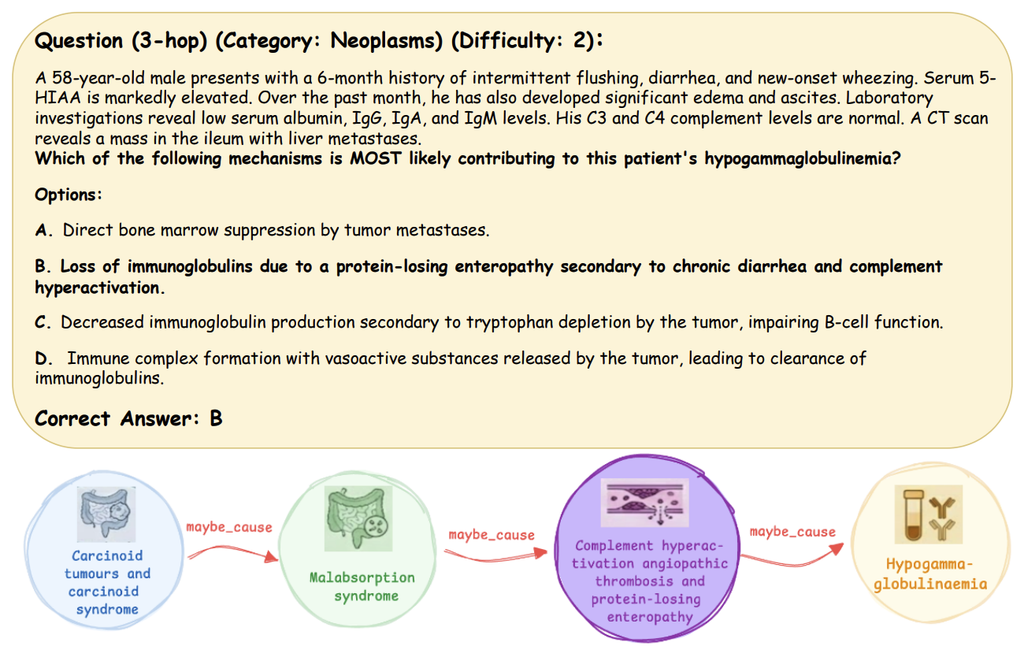
Picture a path that moves from fatigue to iron deficiency, to reduced oxygen transport, and finally to decreased physical performance. Each step is small and grounded, but together they form a coherent explanation.
The key innovation is that instead of rewarding the AI only for getting the final answer right, the model is rewarded for following the correct path through that map. The system checks whether the reasoning aligns with real, structured knowledge – not just whether the answer sounds convincing.
This turns the knowledge graph into what the authors call an “implicit reward model.” Even better, this feedback comes directly from the structure of the graph itself, meaning it can scale without requiring humans to manually evaluate every reasoning step.
Teaching AI to Think, Not Just Answer
Most current AI training is a bit like grading a test based only on the final answer. If the answer looks right, the model gets rewarded, even if it got there by guessing or shaky reasoning.
This work changes that dynamic. The model is now rewarded for intermediate reasoning steps that align with real knowledge. Over time, it learns to construct explanations that are not just plausible, but grounded.
First, the model learns foundational knowledge through supervised training. Then, reinforcement learning provides feedback based on how well its reasoning matches the structure of the knowledge graph.
The authors summarize this dynamic nicely: Supervised learning provides the building blocks, while reinforcement learning teaches the model how to assemble them.
What emerges is something the authors describe as a kind of compositional bridge, a way for the model to connect simple pieces of knowledge into more complex reasoning chains.
What’s remarkable is what happens next. The model is trained only on relatively simple reasoning chains, but when tested on more complex problems, it still improves. It shows clear gains on harder, multi-step tasks, suggesting that it has learned a general skill rather than memorizing specific examples.
Why This Matters
One of the most striking findings is that a relatively modest model, trained this way, can outperform much larger systems on complex reasoning tasks.
That’s a big deal. It suggests that scaling up model size isn’t the only path forward. In some cases, better structure and better training signals can beat brute-force scale.
More importantly, this approach has real-world implications. In domains like medicine, science, and law, it is not enough for an answer to sound right. It has to be right for the right reasons. By grounding reasoning in structured knowledge, this method reduces the risk of confident but incorrect outputs.
It also addresses a subtle but important problem: the “illusion of readiness,” where AI appears capable but breaks down under closer inspection. By forcing models to align their reasoning with verifiable knowledge, this approach moves us closer to systems that genuinely understand what they’re doing.
More broadly, this represents a shift in philosophy. Instead of a top-down approach (training larger and larger models and hoping reasoning emerges), this work takes a bottom-up path where it starts with basic facts, then learns how to combine them.
Final Thoughts: A Smarter Way Forward
This paper feels like a quiet shift in perspective.
Instead of asking how to make AI bigger, it asks how to make AI think better. And the answer turns out to be surprisingly human. That is, start with fundamentals, build step by step, and reward the reasoning process. Not just the final answer.
If this direction continues, we may end up with AI systems that don’t just sound intelligent, but actually reason in ways we can trust.
Next time an AI gives you a confident answer, you might find yourself wondering: Did it truly reason its way there… or did it just get lucky?
Curious to learn more?
Check out the full paper here.
Leave a Reply